Living with Smart Room Controls (SRC) – A Two‑Year Review
A few years ago, smart room controls were being talked about everywhere. They were hailed as the future of heating, with claims of up to 30% energy savings. Plenty has been written about them, but in the early days I wasn’t convinced. The first smart thermostats like Nest, Hive, Tado and others, were essentially app‑driven room stats. They didn’t allow the heat generator to modulate properly and boiler cycling remained unresolved. Anectodically, the early definition of “Smart thermostat” was simply a thermostat operated via a smartphone app, not a device offering genuinely smart control or optimisation.
OpenTherm (an open communication protocol) promised better integration by enabling communication between third‑party controllers and the heat generator. In practice, the data exchange was often poor or restricted, especially on weather‑compensated systems. The unwritten rule seemed to be: if I’m connected, I’m in charge. That meant many of the boiler’s own control features were disabled.
Why manufacturer‑integrated control still wins
The best heating performance comes when the heat generator controls the entire system. Manufacturers with their own communication protocols can coordinate heating circuits, room temperatures, outside temperature, and, crucially, DHW production. I’m still surprised how often boilers are reduced to “dumb” heat sources reacting to a simple on/off switch, with no idea whether the demand is for DHW or one of several heating circuits. Even with some heat pump technologies the industry has adapted old fashion gas boiler philosophy.
With that context, I want to share my experience with Viessmann’s Smart Room Control (SRC) system. I’ve had it installed for more than two years, and this review reflects how it performed; the good, the unexpected, and the UK‑specific quirks. It is to be noted that I am maybe not the stereotype system, but I hope this is still useful to some.
System Overview
My home is heated by a Vitovalor PT2 fuel cell boiler, consisting of:
19 kW peak load boiler
250 L DHW tank (integrated)
750 W hydrogen fuel cell
Low loss header for system separation
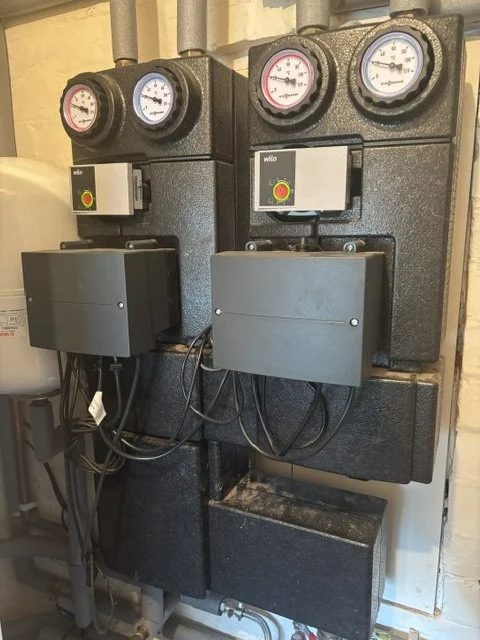
Two VT heating circuits (UFH + radiators) – pump stations with mixers
Fully weather‑compensated, no room thermostats
TRVs on all radiators
Set Heating curves (weather compensated control) :
Radiators: 1.3 (55°C at –5°C)
UFH: 0.9 (42°C at –5°C)
The house itself (1909 solid brick, double glazing, internal insulation) is not inherently efficient, but reasonably improved.
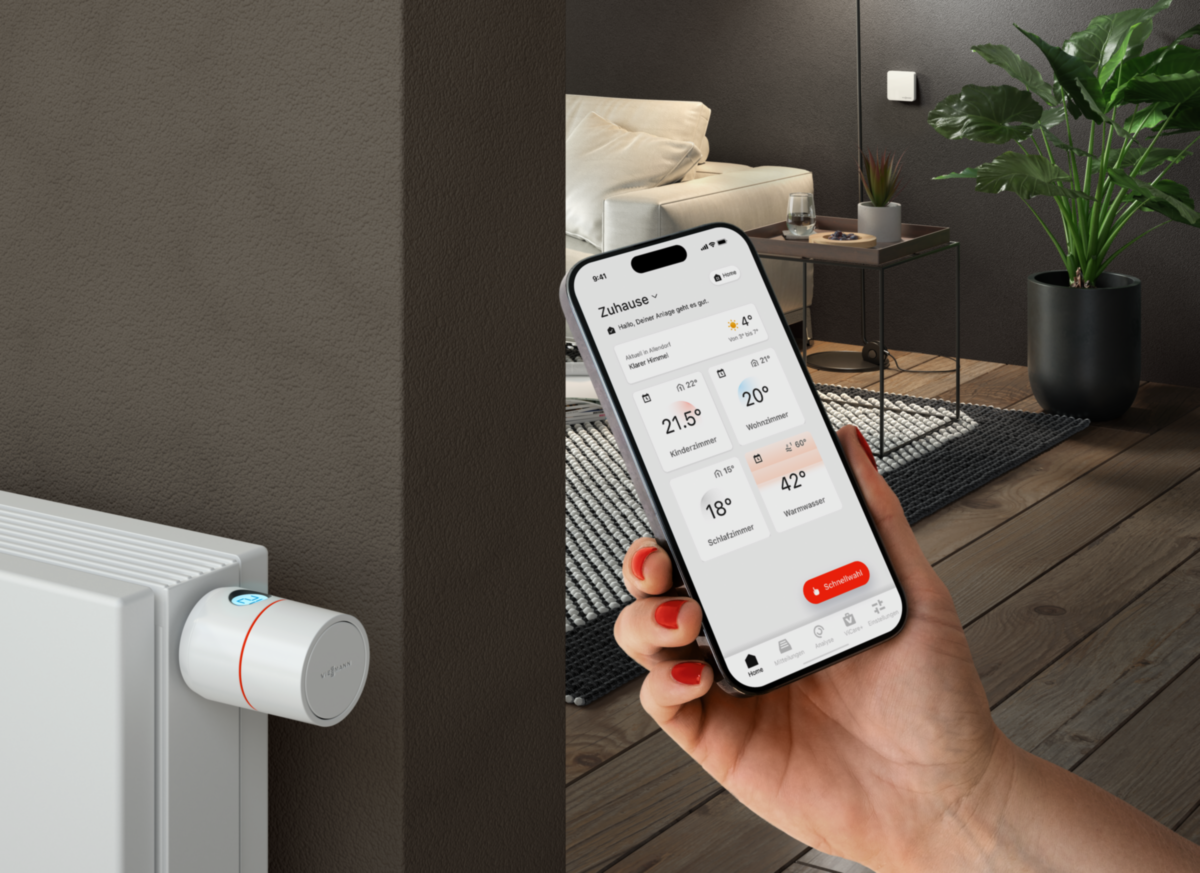
When Viessmann launched the SRC accessories, I replaced all manual TRVs with Viessmann smart radiator valves and added a few room sensors. The Vitovalor already had the modem built in, so setup was simple.
Not every room needs a smart TRV, but the app must be told which rooms are controlled and which ones aren’t. If, for example, two‑thirds of the smart‑equipped rooms shut down, the heat generator will switch off, thus affecting the remaining rooms too. More or less a similar logic as if a room thermostat is fitted in a living room or hall.
The UFH system which runs off a separate variable temperature circuit (VT) remained unchanged.
Performance and the unexpected “fuel cell effect”
Let me start with the headline:
Yes, the SRC saved a little gas - but it also reduced my fuel cell generation!
The fuel cell generates electricity by reforming gas into hydrogen. The longer it runs, the more electricity it generates and thus I self‑consume. In full weather compensation mode, the controller keeps the circulation pumps active even at mild outside temperatures (the system return temperature provides heat demand feedback), allowing also the fuel cell’s 1 kW of “free waste heat” to be absorbed into the system, and therefore hold off the peak boiler.
With smart TRVs, the radiator circuit often shut down earlier. That meant the fuel cell had nowhere to dump its heat, so its run time in spring or early autumn was reduced.
The result:
Fuel cell generation dropped by 8–10% over the year – ca. 3% of total gas consumption
Gas consumption decreased slightly
Grid electricity import increased proportionally!
So while the SRC improved heating control, it also reduced the operational hours of the fuel cell, a nuance worth noting for anyone with similar technology.
Room‑by‑room control and usability
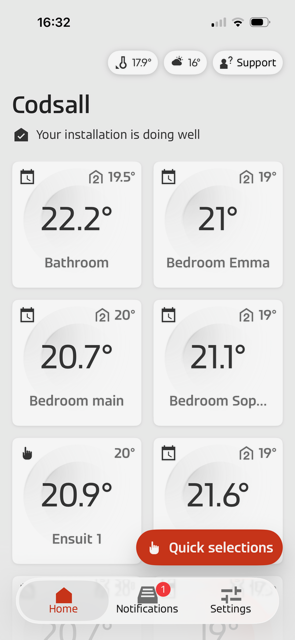
The smart TRVs were impressively accurate. Each room was programmed to its own schedule and temperature (18–21°C), and the ViCare app made adjustments quick and intuitive.
Reliability and Feature Performance
My initial concerns were battery life, noise and wear but also curious about the hydraulic balancing, open‑window detection features, and communication with the heat generator. Here’s how they performed:
Battery life
The supplied 2 × AA batteries lasted 16–24 months or some even longer. Only three of nine TRVs have needed replacements so far. It was also noticeable that the radiators furthest away from the router had to be replaced quicker. Might be just coincidental. Fitting a repeater to ensure good signal strength is certainly an advantage.
Noise
The motors are extremely quiet. Even in bedrooms, when valves are doing their job, or in summer when they occasionally move to prevent sticking, they were barely noticeable.
Wear and tear
Earlier versions had issues with plastic gears wearing down. I’ve seen no such problems with the current generation.
Hydraulic balancing
This was the feature I was most curious about. The system performs balancing without flow meters, temperature sensors, or radiator data. It simply learns:
how quickly each radiator heats up
how long each room takes to reach setpoint
Fast‑heating radiators are throttled back; slow ones are opened more. Over time it builds a surprisingly accurate picture, and it works.
A UK‑specific installation problem
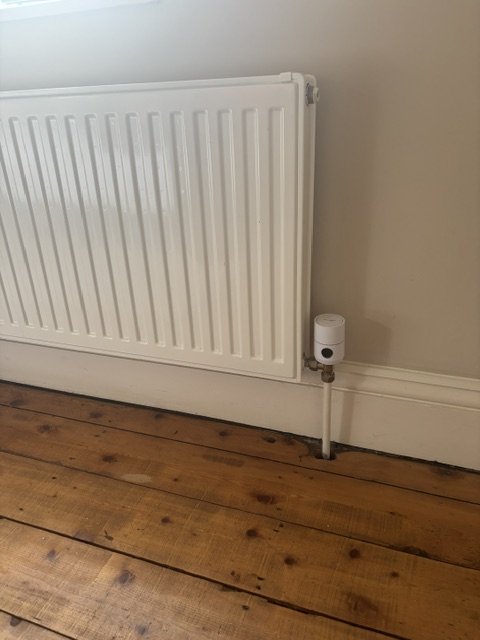
The UK often connects both flow and return at the bottom of the radiator, unlike most of Europe, where the flow enters at the top of the radiator.
This causes a problem:
The TRV sits on a hot valve, heat rises through the body, and the TRV thinks the room is warmer than it is.
The valve shuts down prematurely.
In these cases, a separate ViCare room sensor is strongly recommended.
Open‑window detection
Works well, though bottom‑mounted TRVs can delay the response or won’t work at all. Again, having the TRV at the top part of the radiator proved more accurate.
Communication with the Vitovalor PT2 (or any other Viessmann weather compensated products)
This was my biggest concern — and the biggest positive surprise.
The SRC worked very well with the weather‑compensated system. The mixer valve adjusted smoothly based on room feedback, and during shoulder seasons (May–September) the system often ran solely on fuel cell heat without needing the peak boiler.
Economics — does it make sense?
Smart TRVs are significantly more expensive than manual ones. Third‑party systems (Tado, Honeywell, Hive) typically cost £70+ per head, plus a hub.
The Viessmann ViCare radiator thermostat sits at the upper end of the price range, but its key advantage is native integration with Viessmann boilers and heat pumps. Setup is seamless, and older systems can use a Vitoconnect modem.
A full home upgrade with smart TRVs and/or UFH actuators can easily cost £500–£1,000. Although the system works with third party heat generators, it is more effective when connected to a Viessmann product. Payback is difficult to justify purely on energy savings especially if the existing system is already well‑optimised, as mine was.
However, the value lies in:
convenience
comfort
remote control
room‑by‑room flexibility
integration with the heat generator
For homes with a basic single‑room thermostat, the upgrade to individual room control, especially when integrated with the boiler, can deliver meaningful improvements.
Who benefits most from SRC?
· Home with multiple rooms used at different times
· Properties with radiators either to upgrade with smart TRV’s or replace existing TRV’s
· Systems currently controlled by a single hallway thermostat
· Users who value remote control and automation
· Ideal for Viessmann products (gas boiler or heat pumps) owners who wanting deeper integration
· Also suitable as a stand-alone SRC (third party heat generator)
Summary
Smart room control works best when paired with a Viessmann heat generator
Some gas saving, even if used with a weather compensated system
Excellent room‑by‑room control and comfort
Prevents stuck TRVs after summer
Effective Hydraulic balancing and open‑window detection
Batteries last around two years or longer
Works best with TRVs mounted at the top of the radiator
Fuel cell users should expect reduced generation hours
Overall, the Viessmann SRC system is a reliable, well‑integrated solution that enhances comfort and control, but as always, the benefits depend on the system it’s paired with.
Viessmann Parts Used
Smart TRV on radiator
ViCare app display with Smart Room Control (SRC)
Vitovalor PT2 display and pump station for radiator & UFH circuits